
In running, there is an adage about the marathon often told to the uninitiated racer. It is said that —effort-wise— the halfway point in the 26.2-mile race comes around mile 20. Every step of those last six miles are torturous because of the physical toll from racing the first 20 miles. Twenty miles is a long way, but the journey to those final six miles starts long before that. For Meaghan Borowski that journey started back in the sixth grade and was full of ups and downs as challenging as any found along a marathon’s course.
Borowski first got hooked on running after trying her hand at most of the other sports offered at the time. Her sister, seven years her senior and a member of the high school cross country team, convinced her to give running a shot.
“As for soccer and softball—all those hand-eye sports—I just really did not excel in those,” Borowski recalled with a chuckle. “So, my sister was like ‘try running. Sign up for the cross country and track and field teams, see what you can do.’”
If middle school was when she was first introduced to running, high school was when she fell in love with it, making Minnetonka High School’s varsity team as a freshman. The team atmosphere helped Borowski grow and compete at a high level.
“Freshman year I was fortunate enough to be on the varsity team and just seeing that varsity team be very close-knit and pushing each other was very welcoming.” Borowski said. “Jane, the high school coach, took a liking to me because she did know my older sister so there were times when I would be running super slow, in the back of the pack, with the C-team and everything. I remember she would bike past me and be like, ‘you cannot do this anymore get up in the front. You have to be up in the front.’ That was when I really caught the bug because it was the first time that I recognized my talent.”
Early success didn’t mean her high school career didn’t have any setbacks.
“Sophomore year I was diagnosed with anemia, iron deficiency anemia, and I started running times that were two minutes slower than the year before.” Borowski said. “I was so tired and so sad. That really knocked me down a little bit and really hit my confidence.”
It took Borowski most of her sophomore year to recover from being anemic, taking a prescribed three milliliters of liquid iron three times a day. Her persistence payed off. She improved over the next two years capping off her high school career as a state champion as a member of Minnetonka’s 4×800 meter relay team at the 2014 Minnesota state championships.

After a successful finish to her high school running career, Borowski started looking for opportunities to run in college. She searched for colleges out of state, wanting an opportunity to get away from home and prove her independence. She decided to attend the University of Kansas.
“When I got to Kansas, I was able to try out for the team,” Borowski said. “That was intimidating because I had never had to try out for a team.”
Moving from high school to collegiate athletics is tough and Borowski struggled with the transition.
“Going from top of the pack in my huge high school to the bottom of the pack on a division I, tough team I really took a hit to my confidence as well as to my body,” Borowski said.
During this time at the University of Kansas Borowski developed an eating disorder.
“I had been dealing with some eating disorder issues,” Borowski admitted. “I lost a lot of base strength and nutrition that comes from eating. I made an executive decision and told my parents that this wasn’t for me. That was really hard.”
Borowski decided to step away from the team.
“I really wanted to just fall in love with running again. It had just become such a pressure.” Borowski said. “That’s when I decided to remove myself and start running for myself. I think that put things into perspective again—that I am a strong runner, I am able to complete half-marathons, but I also took it too far with the eating. It was this negative cycle that didn’t allow me to recognize the strengths of my body.” Borowski said.
During this time an old high school teammate reached out to her and convinced her to transfer schools and continue running at the University of Minnesota-Duluth.
“Nothing was really keeping me from KU so I transferred,” Borowski said. “That next track season was the most awkward I’ve felt running because it felt like I was learning how to run again.”
Though her passion for running was reignited she still struggled with her eating. Her coach pressured her to continue unhealthy habits.
“When she suggested to lose fifteen pounds I went and got one of those SlimFast shakes and thought that the skinnier I am the stronger I’ll be and the faster I’ll be,” Borowski said. “That’s such a common misconception in distance athletes. That started causing bone issues for me. “
To find the strength to get through this tough time she turned to her faith and, with the help of her teammates worked through her struggles and started eating and fueling healthily.
“Once I got through that I started feeling more confident in my body. I was fueling properly. I was taking rest days when I needed it.” Borowski said.
After the arduous process of working through her eating disorder Borowski’s running career took another big leap of improvement. At the 2017 NCAA Division II national meet, in her last cross-country race for the UMD Bulldogs, Borowski finished 23rd overall and earned All-American honors.
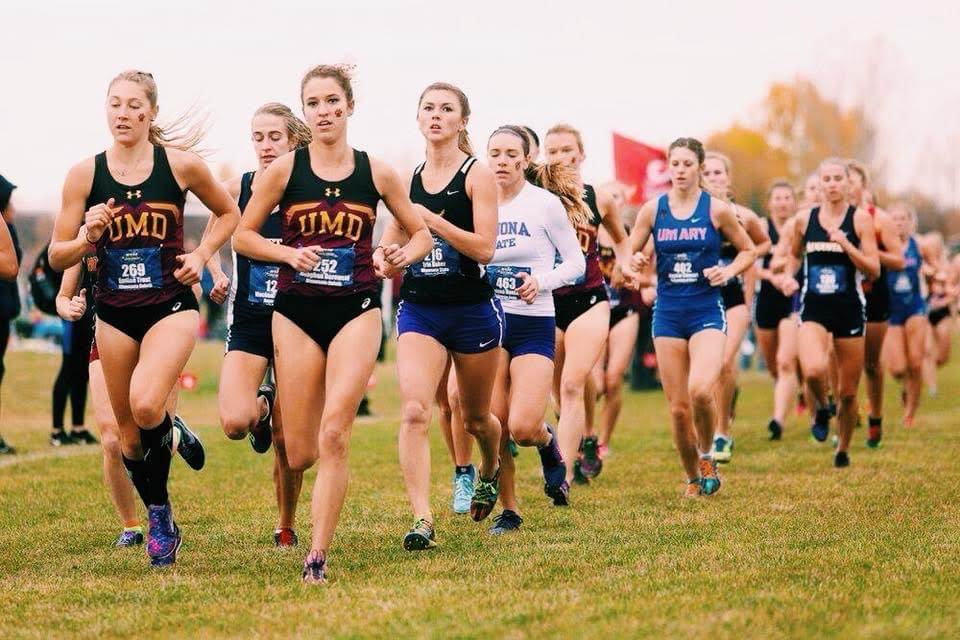
Graduating the University of Minnesota-Duluth with a communications degree and deaf studies minor she dreamed of finding work as a sign language translator.
“I always knew I wanted to do something to help people,” Borowski said, “but with communications, it’s not like nursing, there are endless possibilities. I felt the pressure to just get a job. So, I got a job for a chiropractic clinic. I realized this isn’t what I wanted to do. Then, there was an opportunity for me to coach at a high school… so I quit the chiropractic job and I was a barista part-time, and, in the afternoon, I would go work with these high school students.”
It was then, between shifts at the coffee shop that Borowski found her calling. She decided that she wanted to become a coach, but she knew that, although a start, she wanted to coach at a higher level.
When her soon-to-be fiancé got stationed at Keesler Air Force Base in southern Mississippi, she reached out to the head coach of the University of South Alabama, a Division I school, and got a position as a graduate assistant coach.
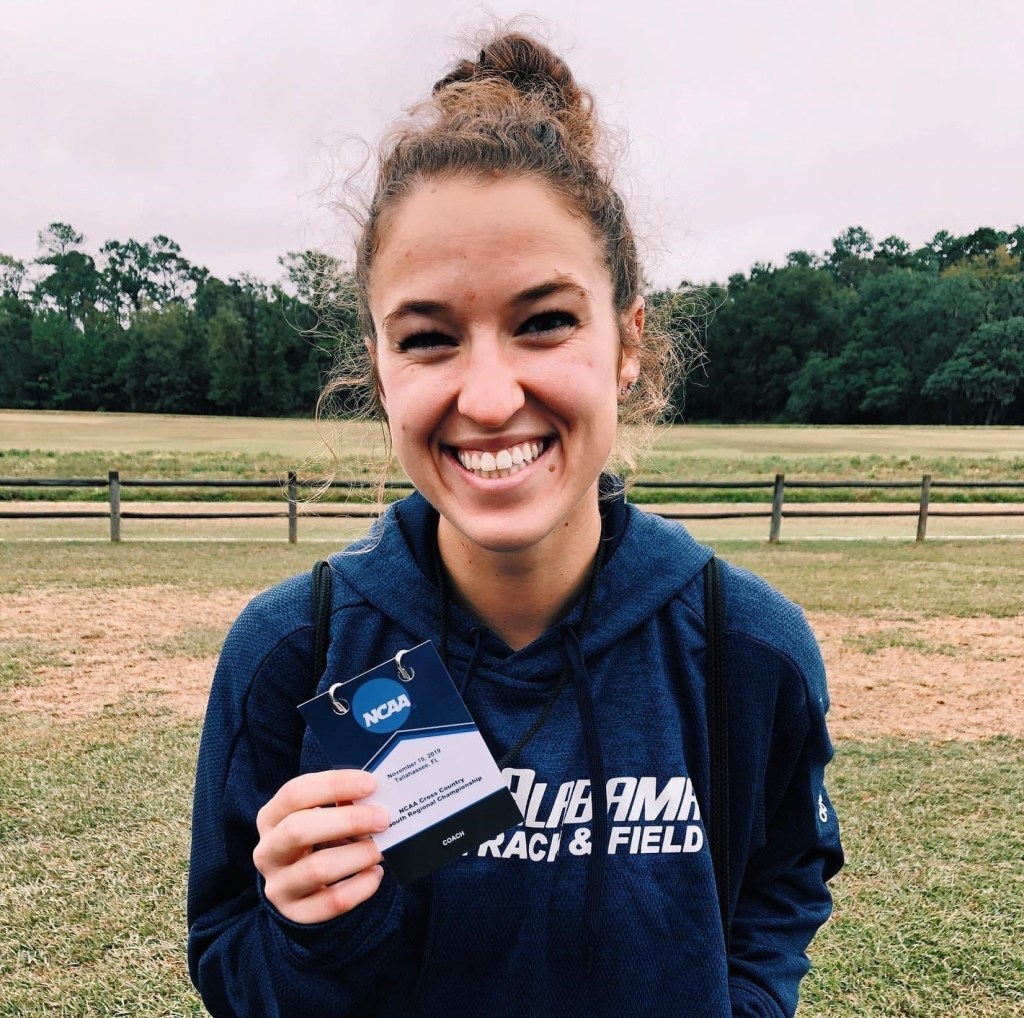
“Her strengths [as a coach] are sitting people down and getting them hyped up,” her fiancé Jordan Koski said. “There have been times where an individual is bummed about their performance, their race, their workout or whatever… Meg still has as many, if not more, encouraging things to say.”
Her experiences as an athlete and the times that she struggled to find the motivation to make it through the hardships in her career have influenced her coaching style. She tries to stay positive and help motivate her athletes to bring out the best in themselves.
“I know Meg does care for her athletes in that way and its cool to see,” Koski said. “She is moving to Omaha soon and she is still making workout plans for the summer for the athletes here. Not because of any other reason besides she cares about them. What people will remember her as being a good coach for is the ability to make you feel good, wanted, loved and on the team.”
Borowski draws on her experiences of her past struggles and uses what she learned personally to help her athletes overcome what troubles they face.
“I’ve really taken the mentality that running is important but its not everything,” Borowski said. “So now [I’m] trying to convey that to student athletes that I’m coaching… that there is going to be so much shit in your life. At every level there will be moments where you doubt yourself and you doubt your abilities but knowing that you have people around you that care for you is really the part that got me through tough times.”
Although she is a coach now, Borowski is still running competitively, trading in the cross-country course and track oval for the paved routes of marathons.
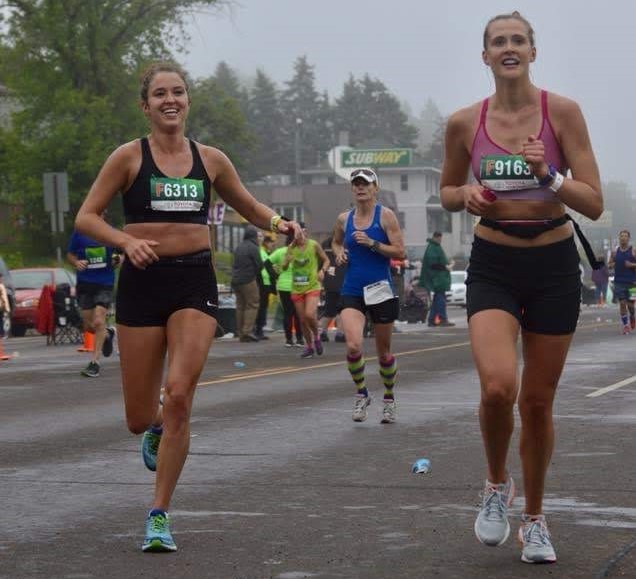
Just last year she completed the life-time goal and childhood dream, of qualifying for the Boston Marathon. She toed the line last April with the words of affirmation “for those who can’t” written down her leg and, when she got to mile 20, she finished the last six miles of the race—those hardest six miles—with a smile on her face.
 Run Fast, Turn, Write